

Research has a bad reputation. Some people might have topics which interest them that they can research with some enjoyment, but as a whole, research is one of those tasks we must simply get done.
What if you are a fiction writer? I’m talking straight up fiction, not historical. You have simply created your own world, therefore, what you say goes. Right? Well, partially, but not necessarily.
Consider this: You are writing fantasy. Fantasy, even if there is a magic system, has a tendency to be set in something similar to the Medieval and/or renaissance periods. Honestly, without a little research most people probably won’t have a solid concept of when these periods were or what distinguished these periods except very generic stuff like, “They were the times of knights, kings, castles, ladies, and peasants.” In other words, most are unlikely to get very far.
We, the inhabitants of the twenty-first century, are so far removed from those eras and lifestyles that we can hardly fathom how those people must have lived. We certainly don’t tend to think about the minutia of their world compared with ours. In essence, someone from the twenty-first century going back to visit those eras would feel almost as though they had been transported to another planet. The reverse scenario would also be true. How did these people live without electricity: no clothes-washer or dryer, no assembly lines, no machines to make their clothes, no cars, no modern ovens, and certainly no microwaves?
Before reading the next paragraph, please note that I do recommend including some tidbits of daily life in a story because it sets the scene, and including something that resembles life makes any story more believable. Reading about a person tending to their daily needs, even if it is in a manner we don’t understand, can help us relate.
Even if we don’t write bits of daily life into our stories, our modern viewpoint would show through. For example, wouldn’t it be easier for our readers to relate if we just have our magic system accomplish the daily tasks so that it’s like having modern conveniences? Why can’t we just do that? You can. It’s your story, but the odds are good that it will look contrived, as though the author wasn’t able to write in anything except a modern mindset, or that they just didn’t care enough to bother, so they used magic as a shortcut. (I mention often that a reader feeling like the author doesn’t care about the story is a huge problem. Please see, “Sneaky Prepositions“, “What is Your Story Worth to You?“)
Understand that I’m not saying that the magic system can’t be used in the same manner as modern conveniences. I’m just saying that it must be done carefully. Also keep in mind, that if a magic system can do anything and everything, there is no difficulty in anything. Once there is no difficulty, there is no tension and no story.
Once upon a time, the protagonist saw there was a problem. They waved their hand and used magic to clean the house, cook the food, and solve the world changing crisis that threatened everyone, and they did it all before lunch. The end.
Ladies and gentlemen, behold, the shortest and most yawn worthy story ever.
Remember what happened to Mickey Mouse when he came up with the “brilliant” idea of using magic to do all his chores? The same thing happens to our stories when we try to use magic to “solve” our lack of knowledge on a subject, writing our characters into a corner, and plot holes.
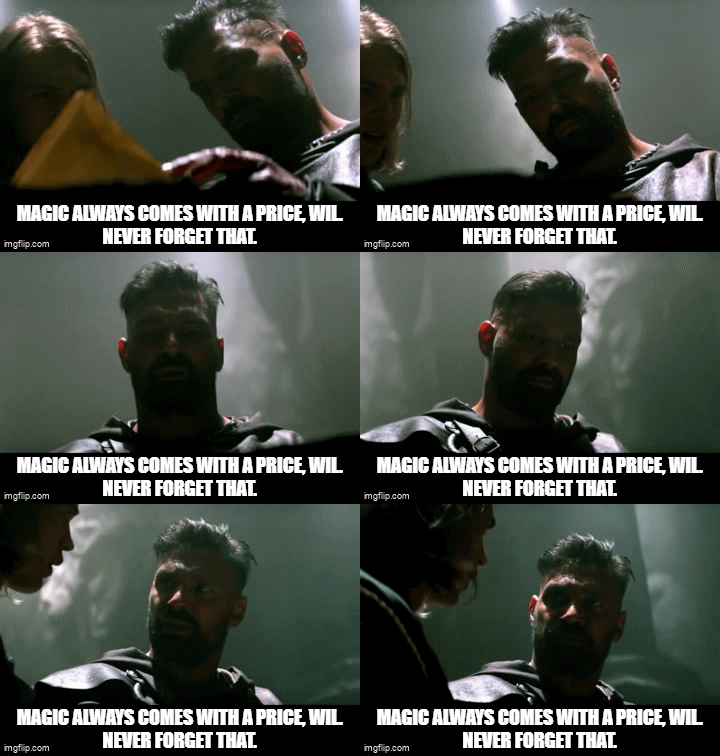
The point is that your magic system needs rules and distinct limitations. In the words of a beloved imp, or a beloved druid, whichever is your favorite, “Magic always has a price.” Difficulty is what makes the story interesting, so let’s assume that magic can’t solve all problems.

Besides the aforementioned reasons not to use magic to avoid research, one of the reasons for reading fantasy is a sense of the “simple life”, of an age without electricity. If that is part of the point, then having magic do the work of modern, electrically powered conveniences, completely defeats that purpose. This lack of things that look like modern conveniences has become almost a necessity in fantasy. You can step out of these expectations, as in the case of urban fantasy, but note that such stories were given a whole category to themselves.
For example, I have a scene in my WIP the “Weavers of Neopia” series where Gramta uses a lesson with a spinning wheel to help my main character understand the magic system. (Note: my “magic” system in these stories is not officially magic. Yes, this does bend the expectations for fantasy a little.) There is another scene where weaving is used to describe the societal structure of the resistance. For the spinning scene, I did the research years ago due to an interest in such work and drew upon that. For the weaving scene, I had to research the terms and make sure I understood what the terms meant in order for the description of the resistance to make sense and be believable.
If research is so important even in fantasy where the author is the creator of the whole world and writes the natural as well as societal laws that govern it, consider how much more important research is for other genres.
With this in mind, another thing you must consider is not just how important it is to do research in the first place, but also, the quality of your research. Imagine if you “research” and find one of those all too common websites written by someone who hasn’t got a clue about their subject. (We’ve all come across one of those from time to time.) This “not having a clue” would transfer to you and nullify the entire point of the research you did.
The rule I am going to give has been a rule of thumb for decades when it comes to research, if one is to do quality research, that is. Pure and simple, the rule of thumb for research is to always find a minimum of two sources that agree with each other. If there is conflicting information, find at least one more source that agrees with one or the other. I would suggest finding three sources that agree if you come across conflicting sources, just to be on the safe side. In our world, we are bombarded with incorrect assumptions stated as facts, and flat out lies. Remember, the more sources you find that agree, the more likely your information is correct. Essentially, you must never take one person’s word as infallibly true.
I understand that, now, in the age of A.I. produced information, this rule becomes a bit more difficult to follow. If anyone has suggestions on how to augment this rule to avoid A.I. hallucinations in our modern world, please leave a comment below to help other writers keep their research solid.
Research is one way we can “write what we know”. If you don’t know it right now, you can know it, to some degree, after you have researched. Then, the details that make a story immersive come more naturally. Believe me, readers know when authors are faking it. Inconsistencies will show up, and the writing will be less confident, making readers less likely to trust the author as a guide. You wouldn’t want to listen to a tour guide who sounds like they’re making things up, would you?
In conclusion, even when researching a subject that interests us little, we are doing it in the best interests of our stories. It becomes a labor of love, and if you don’t love your story enough to give it your best effort, your readers will see it and put the book down without reading any further. So, research. Make sure you are qualified to write the details that will draw your reader into your story. After all, when the reader is drawn in and embraced by the story, they can enjoy the wonder.
If you enjoyed this post, please, share this site with others, and give the post a like. If you want to receive further posts directly to your email before they are posted on my site, subscribe. Feel free to leave a comment or make use of the Contact page.
Discover more from Gear and Pen Stories
Subscribe to get the latest posts sent to your email.